
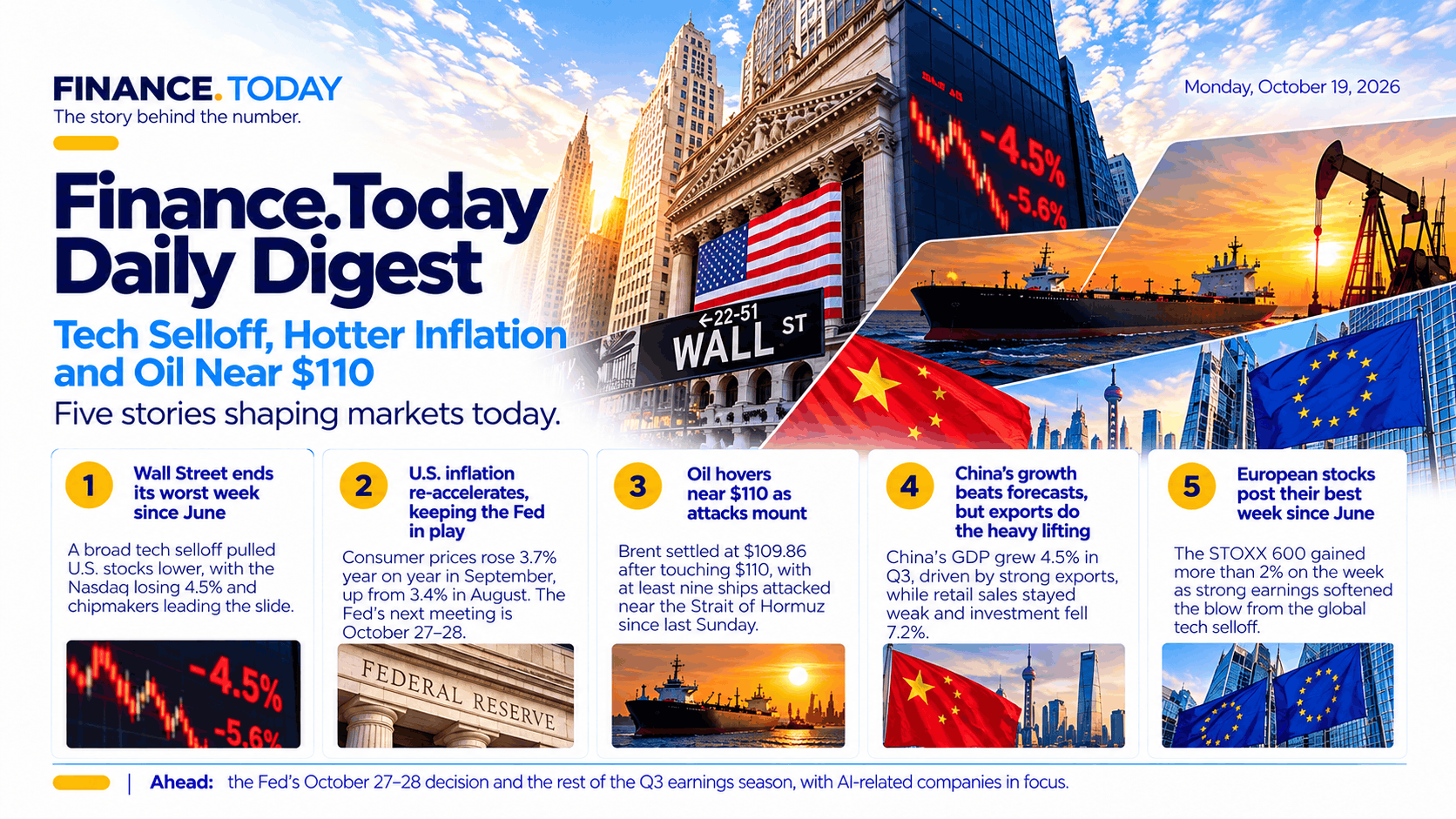

Five stories shaping markets today. Monday, October 19, 2026.
1. Wall Street ends its worst week since June
A broad tech selloff pulled U.S. stocks lower on Friday, closing the worst week since late June. The S&P 500 closed at 7,659.44 and the Nasdaq lost about 4.5% on the week. Chipmakers led the slide: Micron fell 5.6%, AMD 6%, Broadcom 4.5% and Intel 5.8%. Reuters reported that investors fear debt-laden AI infrastructure companies may not turn profits in time to repay borrowing, particularly as borrowing costs are expected to rise.
Why it matters: Most of the S&P 500’s roughly 12% gain this year has come from AI-related tech stocks, while the median stock is up only about 6%. When a handful of stocks carry the index, a setback in them can pull down the whole market.
2. U.S. inflation re-accelerates, keeping the Fed in play
Consumer prices rose 3.7% year on year in September after a 0.6% monthly increase, with gasoline costs a key driver. That is up from 3.4% in August and the highest reading since May. Core inflation, which excludes food and energy, was 2.6%. The Fed raised rates in September for the first time in more than three years, to 3.75%–4.00%. Its next meeting is October 27–28, and one economist called the choice between holding and hiking a “coin flip.”
Why it matters: Inflation is not approaching the Fed’s 2% target. That makes rate cuts unlikely soon and keeps borrowing costs high for households and companies, including the debt-funded AI builders now under pressure.
3. Oil hovers near $110 as attacks mount
Brent settled at $109.86 on Friday after touching $110 for the first time since May, while U.S. crude ended at $101.41. At least nine ships have been attacked near the Strait of Hormuz since last Sunday, and shipments through it are about 70% of their pre-war level. Over the weekend, Ukrainian drone strikes started fires at an oil terminal and depot in St. Petersburg, and two tankers were attacked in the Persian Gulf. Brent slipped back below $109 in early Asian trading today.
Why it matters: Energy costs feed straight into consumer prices. Gasoline was a key driver of September’s inflation, and the ECB has cited oil-driven price pressures for its rate hikes this year. Higher crude makes the job of central banks harder.
4. China’s growth beats forecasts, but exports do the heavy lifting
China’s GDP grew 4.5% in the third quarter, up from 4.3% in the second, but retail sales rose just 1.1% in September and fixed-asset investment fell 7.2% in January–September. Chip and electronics exports, boosted by the global AI boom, drove the result, and exports to the U.S. jumped 39.6% year on year in September. The IMF earlier this month trimmed its 2026 forecast for China to 4.5%.
Why it matters: Exports will likely stay strong, but global trade barriers remain a risk, and one economist warns that the headline growth figure is an increasingly poor guide to the broader economy. Growth that depends on foreign demand is exposed if that demand slows.
5. European stocks post their best week since June
The STOXX 600 rose 0.7% to 644.74 on Friday, gaining more than 2% on the week as strong earnings softened the blow from the global tech selloff. Analysts expect third-quarter earnings for STOXX 600 companies to rise 20.7% from a year earlier, while the ECB has raised rates by 50 basis points in 2026 to 2.50%.
Why it matters: The week’s pain was concentrated in AI-linked tech, not spread across all markets. Solid corporate earnings can cushion a selloff, though Europe faces the same inflation and oil pressures as the U.S.
Ahead: the Fed’s October 27–28 decision and the rest of the Q3 earnings season, with AI-related companies in focus.
Sources: AP, Reuters, CNBC, The Hill, CNN, BLS.
For information only, not investment advice.
The story behind the number.
