
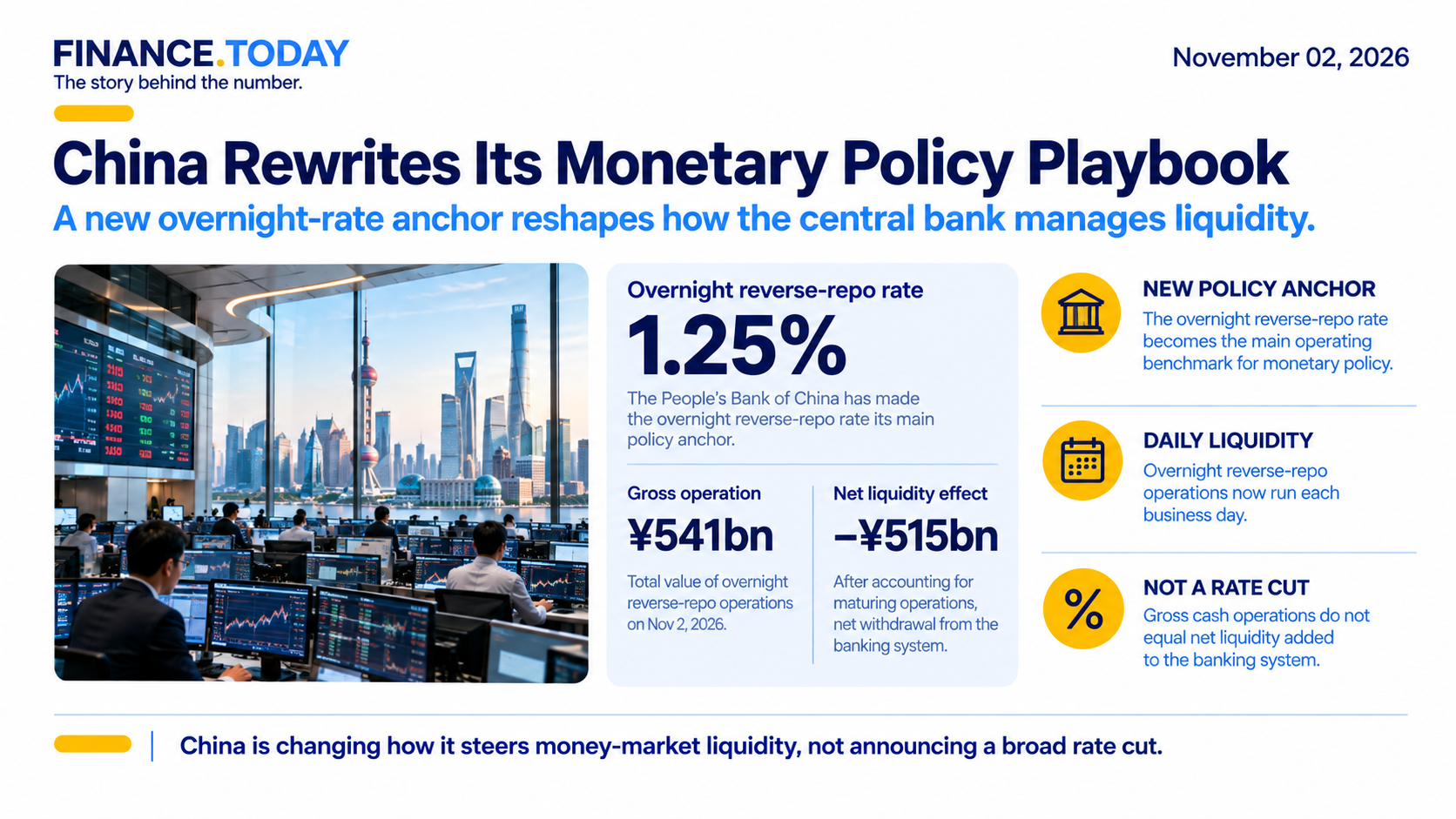

China’s central bank has introduced a significant change to the way it manages money-market liquidity. On November 2, the People’s Bank of China (PBOC) formally shifted its main policy-rate anchor to the overnight reverse repo rate, setting the operating rate at 1.25%.
The new framework replaces the seven-day reverse repo rate as the central reference for short-term funding operations. The PBOC will now conduct overnight reverse repo operations every business day, while seven-day operations will use multiple-rate tenders and be concentrated around periods of higher liquidity demand, such as tax dates and month-ends.
The central bank conducted 541 billion yuan ($81.3 billion) in overnight reverse repo operations on the first day. However, the gross figure does not represent a net injection: after accounting for maturing operations, the banking system experienced a net liquidity withdrawal of 515 billion yuan, according to Bloomberg. Analysts estimate that the framework change effectively lowers the floor of China’s interest-rate system by 15 basis points, easing funding conditions for financial institutions.
The distinction matters. This is not a conventional interest-rate cut or a guarantee of broad economic stimulus. Instead, Beijing is refining the mechanism through which monetary policy reaches banks and financial markets. The real test will be whether more precise liquidity management can stabilise financial institutions, improve credit transmission and support economic activity without creating new financial risks.
The Story Behind the Number.
— finance.today
