
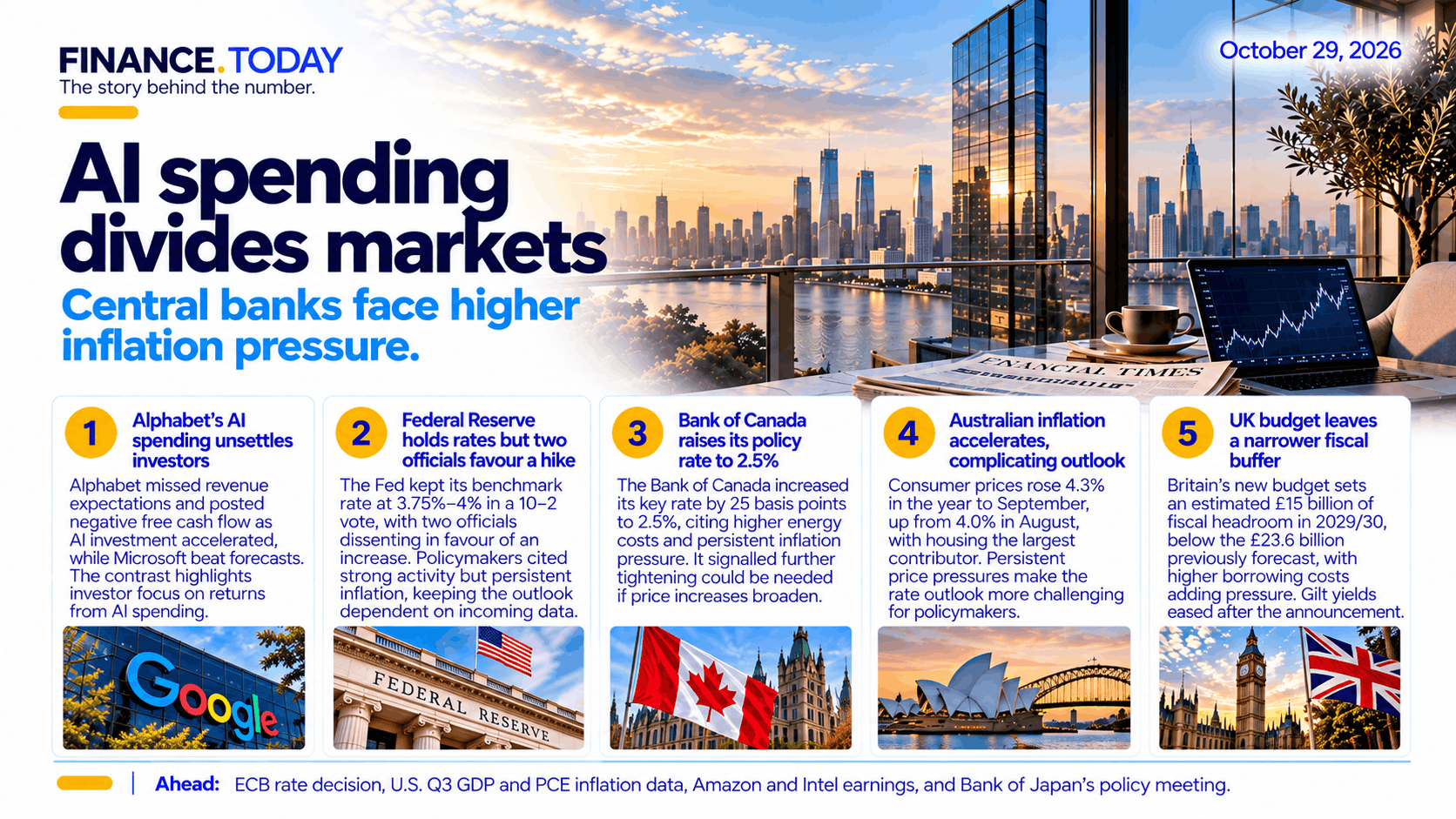

Five stories shaping global markets and business on October 29, 2026.
1. Alphabet’s AI Spending Unsettles Investors
Investors gave sharply different reactions to the latest results from two major technology companies. Alphabet missed Wall Street’s revenue expectations, and its free cash flow turned negative at $9.07 billion as AI-related investment accelerated. Its shares fell around 10% in after-hours trading. Microsoft, by contrast, rose about 3% after reporting stronger-than-expected cash flow, while Azure growth accelerated to 48%. The contrast highlights the market’s central question about AI: strong demand is encouraging, but investors increasingly want evidence that infrastructure spending can generate durable revenue and cash returns.
2. Federal Reserve Holds Rates but Two Officials Favour a Hike
The Federal Reserve kept its benchmark interest-rate range at 3.75%–4% on October 28, in a 10–2 vote. Officials Lisa Cook and Beth Hammack dissented in favour of a quarter-point increase. The central bank described economic activity as strong but said inflation remained elevated, leaving future policy dependent on incoming data. The decision did not settle the outlook for borrowing costs: investors must weigh resilient activity and investment against persistent price pressures. The Fed’s stance also raises the importance of upcoming inflation and growth releases for Treasury yields, the dollar and equity valuations.
3. Bank of Canada Raises Its Policy Rate to 2.5%
The Bank of Canada raised its overnight policy rate by 25 basis points to 2.5% on October 28, its first increase in more than three years. The bank said higher energy costs were adding to inflation pressure and warned that further tightening could be needed if price increases spread more broadly. Its updated outlook put inflation near 3% through much of 2027 before returning close to 2% around mid-2028. The decision shows how central banks may respond differently to persistent inflation, even as markets debate whether higher rates risk slowing economic activity.
4. Australian Inflation Accelerates, Complicating the Outlook
Australia’s consumer price index rose 4.3% in the year to September, up from 4.0% in August, according to the Australian Bureau of Statistics. Trimmed-mean inflation, which smooths some volatile price movements, also edged higher to 3.6% from a revised 3.5%. Housing was the largest contributor to annual inflation, rising 5.2%. The figures complicate the task facing policymakers: headline price growth is moving further from the central bank’s target, while underlying inflation remains elevated. Persistent price pressure could mean borrowing costs stay restrictive for longer, affecting households, businesses and investment.
5. UK Budget Leaves a Narrower Fiscal Buffer
Britain’s budget leaves the government with an estimated £15 billion of fiscal headroom in 2029/30, according to forecasts from the Office for Budget Responsibility reported by Reuters. That is below the £23.6 billion estimated in the previous March update, with higher borrowing costs adding to pressure on public finances. Government bond yields eased after the budget and planned debt issuance update, suggesting the immediate response was measured rather than a sharp repricing. The longer-term test is whether the government can meet its fiscal rules while supporting households and businesses and maintaining investor confidence.
Ahead
Investors will focus on the European Central Bank’s policy decision and press conference on October 29, followed by the US advance estimate of third-quarter GDP and September personal income and outlays, including the PCE inflation measures. Amazon and Intel results are also due, while the Bank of Japan’s decision is expected on October 30. These events may offer further clues about the outlook for interest rates, inflation and corporate investment.
Sources: Reuters, The Wall Street Journal, Federal Reserve, Bank of Canada, Australian Bureau of Statistics, Office for Budget Responsibility, European Central Bank.
This digest is for informational purposes only and does not constitute investment advice.
The story behind the number.
— finance.today
