
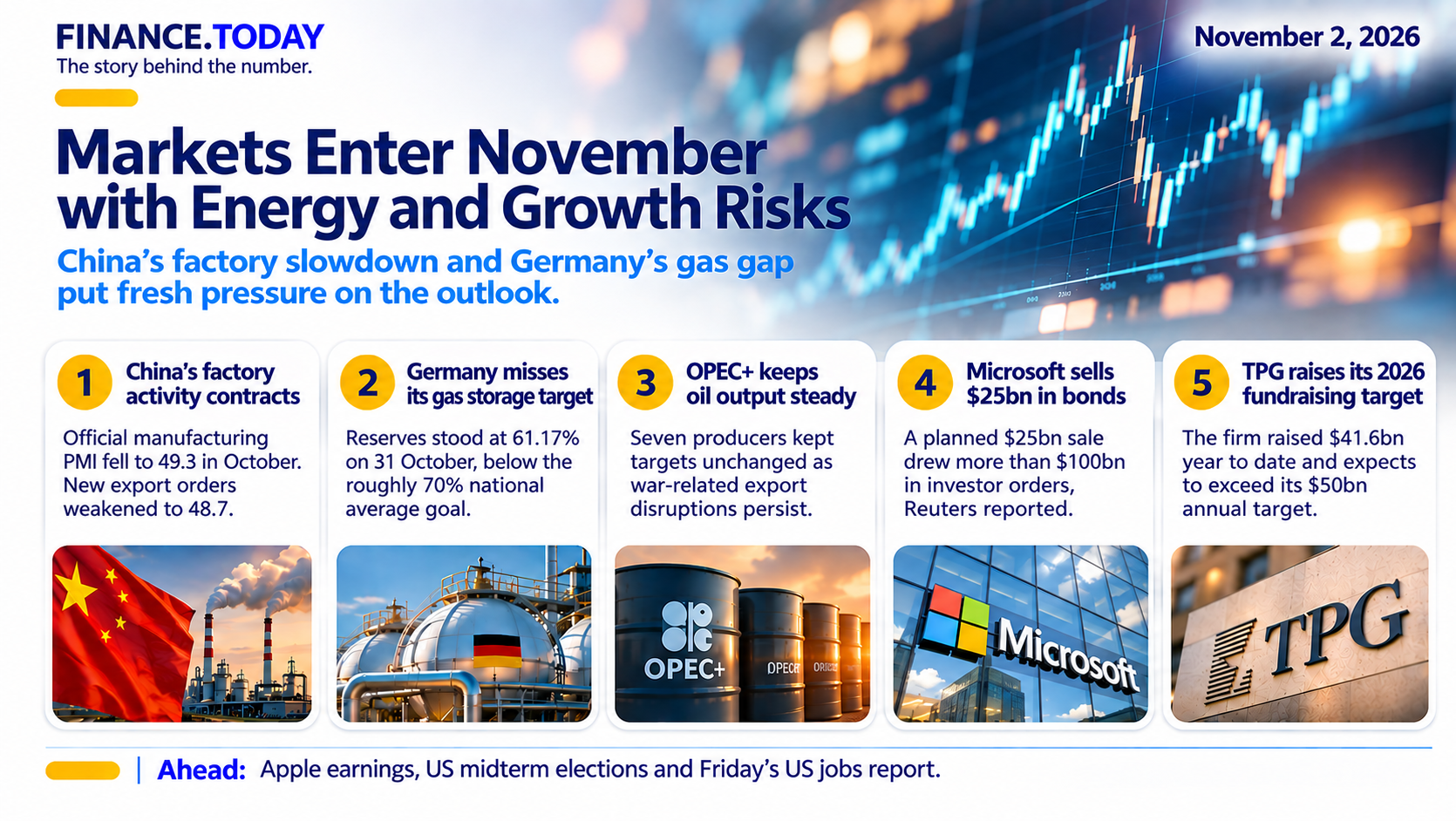

Five stories shaping global markets and business on November 2, 2026.
1. China’s factory activity contracts
China’s official manufacturing Purchasing Managers’ Index fell to 49.3 in October, down from 50.1 in September, moving back into contraction territory. The new export orders index dropped to 48.7, while the production index stood at 49.8. The figures point to weakening industrial momentum and softer external demand. For global markets, the slowdown matters because China remains a major driver of manufacturing, commodity consumption and international trade. Persistent weakness could add pressure to exporters and businesses exposed to Chinese demand.
2. Germany misses its gas storage target
Germany’s gas reserves stood at 61.17% of capacity on 31 October, below the roughly 70% national average target for the start of November. The shortfall raises concerns about the country’s energy security as the heating season begins. Lower storage levels leave less room to absorb supply disruptions or periods of stronger demand. For Europe’s largest economy, energy availability remains a critical factor for industrial competitiveness, operating costs and the wider economic outlook.
3. OPEC+ keeps oil output steady
Seven key OPEC+ producers agreed to maintain their required production levels for December, keeping output targets unchanged from September. The decision comes as energy markets continue to assess geopolitical risks and disruptions to exports. Stable production targets offer no immediate increase in planned supply, leaving prices sensitive to changes in demand and potential interruptions. The next full OPEC+ meeting, scheduled for 29 November, will be important for determining the group’s production framework for 2027.
4. Microsoft sells $25bn in bonds
Microsoft is preparing a US investment-grade bond sale of around $25bn, its first such offering in more than nine years. Investor orders reportedly exceeded $100bn, signalling strong demand for the company’s debt. The planned transaction comes as technology companies continue to commit substantial capital to AI infrastructure, including data centres and computing capacity. For bond investors, the scale of demand highlights the market’s appetite for highly rated corporate borrowers, even as questions grow around the long-term returns on AI investment.
5. TPG raises its 2026 fundraising target
TPG raised $41.6bn during the first nine months of 2026 and expects to exceed its $50bn annual fundraising target. The firm also reported a record $86bn in available investment capital, known as dry powder. The figures point to continued investor demand for private-market strategies and give the alternative asset manager substantial capacity for future deals. The pace of fundraising will be closely watched as private equity firms navigate higher financing costs, valuation pressures and competition for attractive investments.
Ahead
Attention now turns to Apple’s upcoming earnings, the US midterm elections and Friday’s US employment report. Corporate results will offer another indication of how businesses are managing investment and demand, while the jobs data could influence expectations for the Federal Reserve’s next policy steps. Energy-market developments also remain important as Europe enters the winter season.
Sources: Associated Press, Reuters, Financial Times, Bloomberg, Organization of the Petroleum Exporting Countries, TPG, U.S. Securities and Exchange Commission.
This digest is for informational purposes only and does not constitute investment advice.
The story behind the number.
— finance.today
