
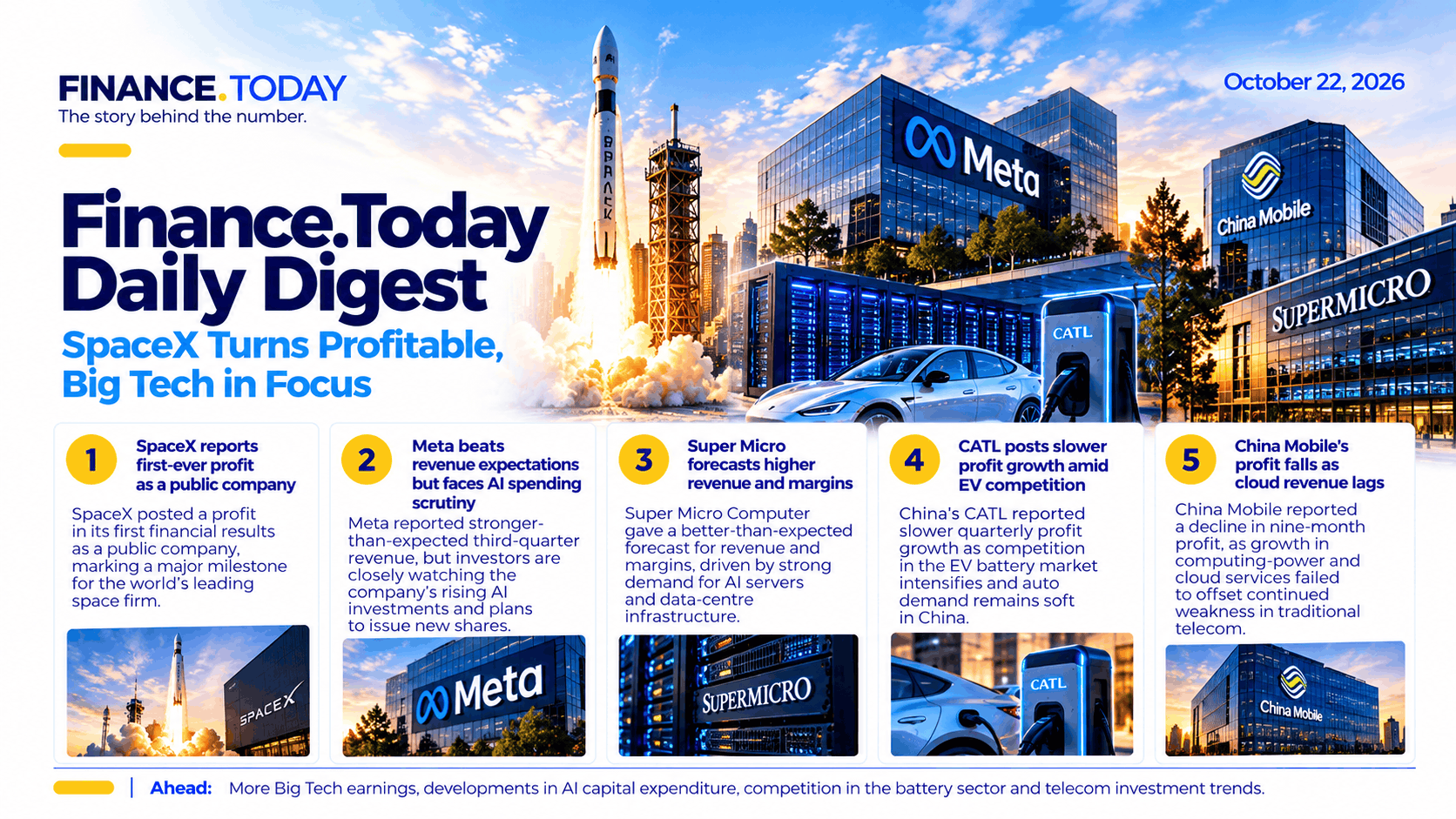

Five stories shaping global markets and business on October 22, 2026.
1. SpaceX Turns Profitable as AI Becomes a Major Growth Engine
SpaceX reported a remarkable third-quarter turnaround, with revenue surging 161% year over year to $14.6 billion and net income reaching $4.4 billion. A year earlier, the company had recorded a $1.1 billion loss.
The results reflect the rapid expansion of SpaceX’s artificial intelligence business alongside continued growth in satellite connectivity. Starlink remains a significant part of the company’s operations, but AI and computing infrastructure are becoming increasingly important to its growth strategy.
The financial milestone comes with a substantial spending commitment. SpaceX is investing heavily in computing capacity and infrastructure to support its expanding AI operations. Its challenge now is to sustain growth while ensuring that the capital required to expand does not undermine long-term financial performance.
Why it matters: SpaceX illustrates how quickly the economics of a technology business can change when new revenue streams scale. But profitability in one quarter is only part of the story. Investors will be watching whether the company can maintain earnings momentum while funding its ambitious expansion plans.
2. Meta Beats Revenue Expectations as Investors Assess the Cost of AI
Meta reported third-quarter revenue of $64.6 billion, up 26% year over year, as its core business continued to generate substantial sales. Net income reached $9.86 billion, although the comparison with the previous year was affected by significant tax-related items.
The company is simultaneously increasing its commitment to artificial intelligence. Meta expects full-year 2026 capital expenditure of $135 billion to $145 billion as it builds infrastructure and develops AI products and models.
That spending reflects a broader strategic bet: AI could improve advertising performance, support new products and create additional sources of revenue. However, building the infrastructure needed to compete at the frontier of AI requires enormous financial resources, and shareholders will want evidence that those investments can generate attractive returns.
Why it matters: Meta’s results highlight the tension between strong operating performance and rising investment requirements. Revenue growth gives the company room to spend, but the longer-term test is whether AI creates enough additional value to justify the cost.
3. Super Micro Raises Its Forecast on Strong AI Server Demand
Super Micro Computer issued a stronger-than-expected outlook for its fiscal first quarter, forecasting revenue of $18.5 billion to $19.5 billion. It also projected gross margins of 12% to 12.5%, above its previous guidance.
The updated outlook points to continued demand for AI servers and the infrastructure required to run increasingly sophisticated computing systems. As technology companies expand their data-centre capacity, suppliers of servers and related hardware are benefiting from the investment cycle.
Yet strong demand does not guarantee that every supplier will achieve lasting profitability. Hardware companies must manage production costs, supply chains, customer concentration and pricing pressure while delivering increasingly complex systems at scale.
Why it matters: Super Micro provides a direct view of the infrastructure behind the AI boom. Its outlook suggests that demand remains substantial, but investors will need to distinguish revenue growth from sustainable margin improvement as competition intensifies.
4. CATL Faces a Profitability Test Despite Strong Revenue Growth
Contemporary Amperex Technology Co. Limited (CATL), one of the world’s leading electric-vehicle battery manufacturers, reported third-quarter revenue of 165.2 billion yuan, up 58.6% year over year. Net profit rose 14.5% to 21.2 billion yuan, considerably more slowly than revenue.
The gap between sales and earnings growth highlights the pressures facing China’s electric-vehicle supply chain. Intense competition, slower growth in domestic vehicle sales and changes in product mix can limit how much additional revenue translates into profit.
The longer-term outlook for electrification remains significant, but the industry is becoming more demanding for manufacturers. Scale and technological capabilities matter, yet pricing power and cost discipline increasingly determine which businesses can convert market growth into stronger earnings.
Why it matters: CATL’s results show why investors should look beyond headline revenue growth. In competitive industries, a company can expand rapidly while facing pressure on profitability. Margins, pricing and the quality of growth are essential indicators of financial resilience.
5. China Mobile’s Profit Declines as Its Business Model Evolves
China Mobile reported a 7.9% year-over-year decline in profit attributable to shareholders for the first nine months of 2026, to 106.2 billion yuan. Operating revenue fell 1.8% to 780.3 billion yuan as weakness in traditional telecommunications services weighed on performance.
The company has been expanding into newer areas, including cloud computing and digital infrastructure, as it seeks to diversify beyond its established telecom business. These services offer opportunities for future growth, but they have not yet fully offset the pressure on the traditional business.
The transition reflects a challenge shared by many mature companies. Entering faster-growing technology markets requires investment, new capabilities and time. Meanwhile, established revenue streams still need to generate sufficient cash to support the transformation.
Why it matters: China Mobile illustrates that digital transformation is a process, not an immediate financial fix. The key question is whether newer services can eventually become large and profitable enough to compensate for slower growth in the core business.
Ahead
Upcoming technology earnings will provide further clues about AI infrastructure spending, demand for computing capacity and the returns companies expect from their investments. Investors will also be watching competition and profitability across China’s electric-vehicle supply chain, alongside the progress of telecom operators diversifying into cloud and digital services.
The central question remains: which companies can translate rapid change into durable earnings growth?
Sources: AP, Reuters, CNBC, The Hill, CNN, BLS.
For information only, not investment advice.
The story behind the number.
— finance.today
