
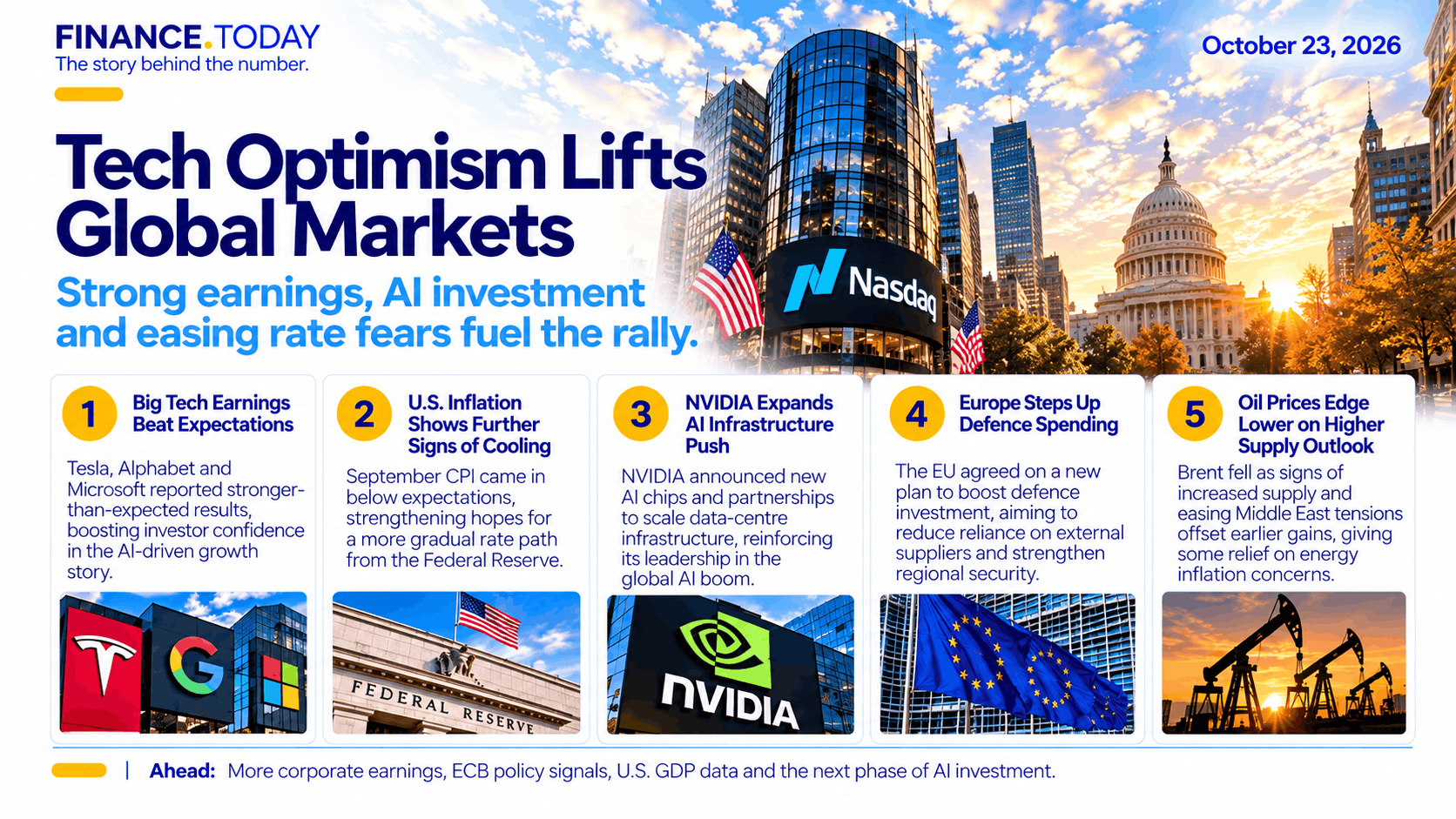

Five stories shaping global markets and business on October 23, 2026.
1. Global Markets Reassess the Cost of the AI Boom
Global stocks came under pressure as investors questioned whether massive investments in artificial intelligence can deliver returns quickly enough. The Nasdaq fell 2.6%, while the S&P 500 lost 1.2% in its worst session since July. Asian markets were mixed as investors reassessed the cost of data centres, AI chips and the financing required to sustain the boom.
2. Meta’s AI Ambitions Face a Financing Test
Meta shares fell nearly 8% after the company signalled that its AI ambitions are putting increasing pressure on its finances. The company is exploring non-voting shares as a way to raise capital while funding its technology investments. The reaction highlights a growing investor concern: even the largest technology companies may need to prove that escalating AI spending can translate into sustainable returns.
3. Tesla Pulls Back on Planned Capital Spending
Tesla lowered its planned capital expenditure for 2026 to $20 billion from an earlier estimate of $25 billion. The revision comes as investors scrutinise how companies allocate capital amid economic uncertainty and rising costs. For markets, the move raises a broader question: are businesses becoming more selective about large-scale investment, even in strategically important sectors?
4. U.S. Inflation Accelerates as Energy Costs Rise
U.S. consumer prices rose 0.6% in September, bringing annual inflation to 3.7%, up from 3.4% in August. Energy was a major driver: gasoline prices climbed 9.1% during the month, accounting for more than half of the monthly increase in the overall index. Core inflation, which excludes food and energy, rose 0.3% month on month and 2.6% year on year. Persistent inflation could complicate the Federal Reserve’s decisions on interest rates.
5. Oil Prices Surge as Geopolitical Risks Return to Focus
Brent crude rose above $114 a barrel, reaching its highest level in around five months amid renewed Middle East tensions and concerns over regional security and shipping routes. Higher oil prices can feed into transport, production and household energy costs, potentially adding to inflationary pressure just as investors are watching central-bank policy closely.
Ahead
Investors will be watching upcoming corporate earnings, signals on U.S. inflation and interest rates, and developments in the Middle East. The key question is whether companies can justify rising technology investment while energy costs and financing pressures remain elevated.
Sources: Reuters, Associated Press, U.S. Bureau of Labor Statistics.
This digest is for informational purposes only and does not constitute investment advice.
The story behind the number.
— finance.today
