
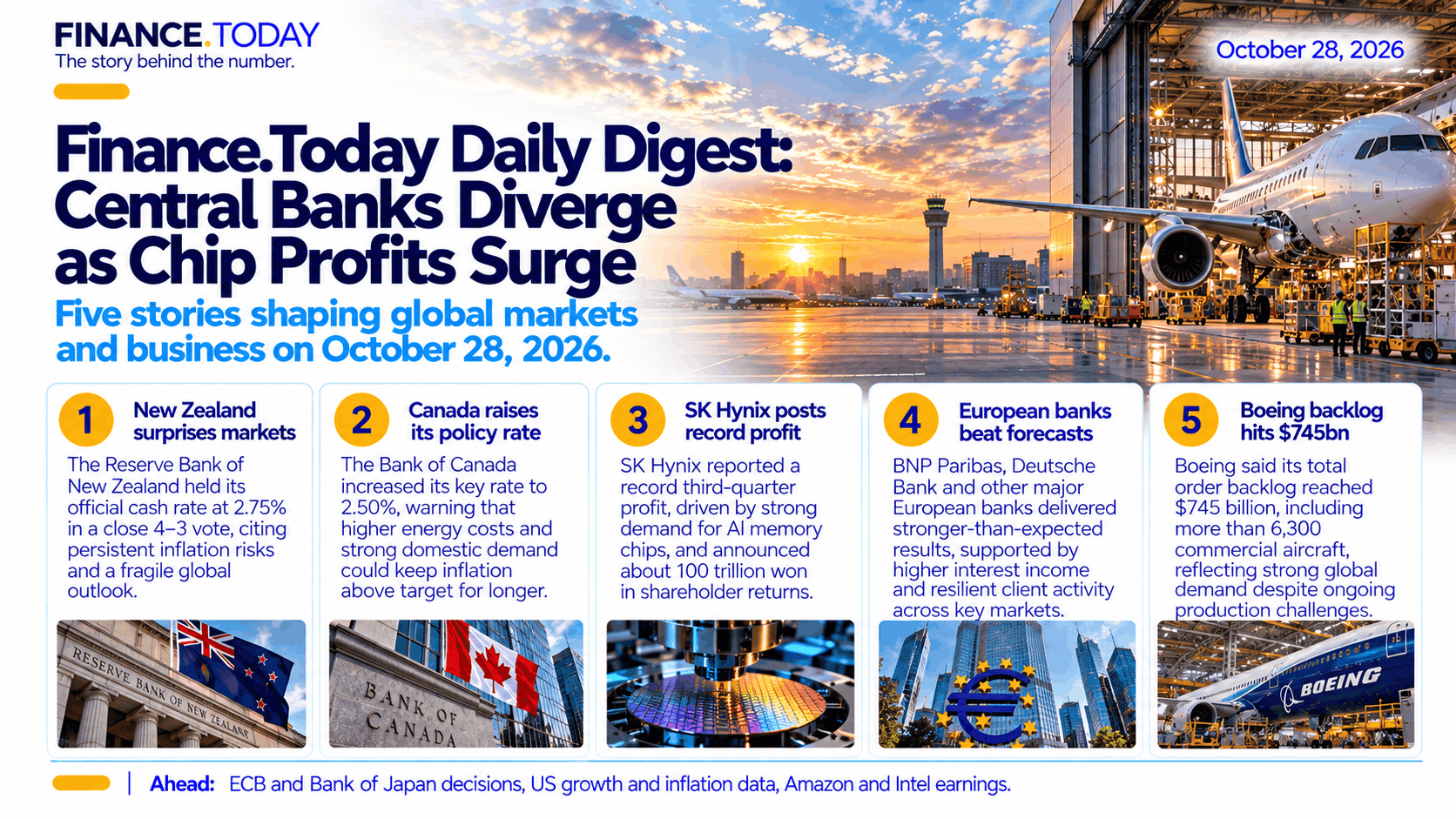

Five stories shaping global markets and business on October 28, 2026.
1. New Zealand surprises markets with a rate hold
The Reserve Bank of New Zealand kept its official cash rate at 2.75%, despite expectations of an increase. The decision passed by four votes to three, with three policymakers favouring a quarter-point hike. The New Zealand dollar fell sharply after the announcement, reflecting how heavily markets had positioned for tighter policy. Annual inflation eased to 3.7% in the September quarter, but policymakers warned that higher fuel costs and broader price pressures could still require further tightening. The decision highlights how central banks are balancing inflation risks against uneven economic recoveries.
2. Bank of Canada raises rates as inflation risks build
The Bank of Canada raised its overnight rate by 25 basis points to 2.50%, its first increase in more than three years. The bank said persistently high energy prices could spread into wider inflation, leaving the possibility of further tightening open. It raised its forecast for 2027 inflation to 3.1%, from 2.0% previously, and projected 2026 economic growth of 1.0%, up from its earlier 0.7% estimate. The move contrasts with New Zealand’s decision to wait, underscoring how central banks are responding differently to a shared energy-driven inflation shock.
3. SK Hynix posts record profit and pledges $75 billion to shareholders
South Korean chipmaker SK Hynix reported record third-quarter revenue of 104.6 trillion won and operating profit of 83.3 trillion won, supported by demand for memory used in AI infrastructure. The company also outlined shareholder returns of around 100 trillion won, equivalent to approximately $75 billion, for 2026. It said demand for high-bandwidth memory and conventional DRAM remained strong, with output effectively booked through 2029 and supply constraints potentially lasting longer. The results strengthen the case for sustained demand in the memory-chip market, while raising questions about capacity expansion and the durability of current pricing.
4. European banks beat earnings forecasts, but risks remain
Several major European lenders reported stronger-than-expected third-quarter results. BNP Paribas increased net income by 14% to €3.46 billion and announced a €1.3 billion share buyback. Deutsche Bank also beat forecasts, while Standard Chartered raised its income and profitability targets. UBS reported net profit of $2.69 billion and accelerated its share-repurchase programme. Yet investor confidence remains fragile: banking shares had fallen around 10% over the preceding month amid concerns about government-debt exposure, deposit competition and slower growth. The results suggest banks remain profitable, but markets are questioning how resilient those earnings will be if financial conditions tighten.
5. Boeing’s backlog reaches a record $745 billion
Boeing reported a record total order backlog of $745 billion, including more than 6,300 commercial aircraft, as it continued to rebuild its business. Third-quarter revenue rose 4% year on year to $24.2 billion, while operating cash flow reached $1.5 billion. The company nevertheless recorded a GAAP net loss of $116 million, illustrating that a strong order book does not automatically translate into near-term profitability. Investors will be watching whether Boeing can convert demand into reliable deliveries, improve margins and sustain cash generation as its commercial and defence programmes progress.
Ahead
Markets will turn to the European Central Bank and Bank of Japan policy decisions, alongside results from major US companies including Amazon and Intel. Investors will also watch US growth and inflation data for evidence that energy costs are feeding into broader prices. These releases could shift rate expectations and influence currency, bond and equity markets.
Sources: Reuters, Reserve Bank of New Zealand, Bank of Canada, SK hynix, The Boeing Company.
This digest is for informational purposes only and does not constitute investment advice.
The story behind the number. — finance.today
