

The world’s largest crypto exchange says it can absorb the record-breaking theft. But billions in customer withdrawals show that confidence is harder to restore than liquidity.
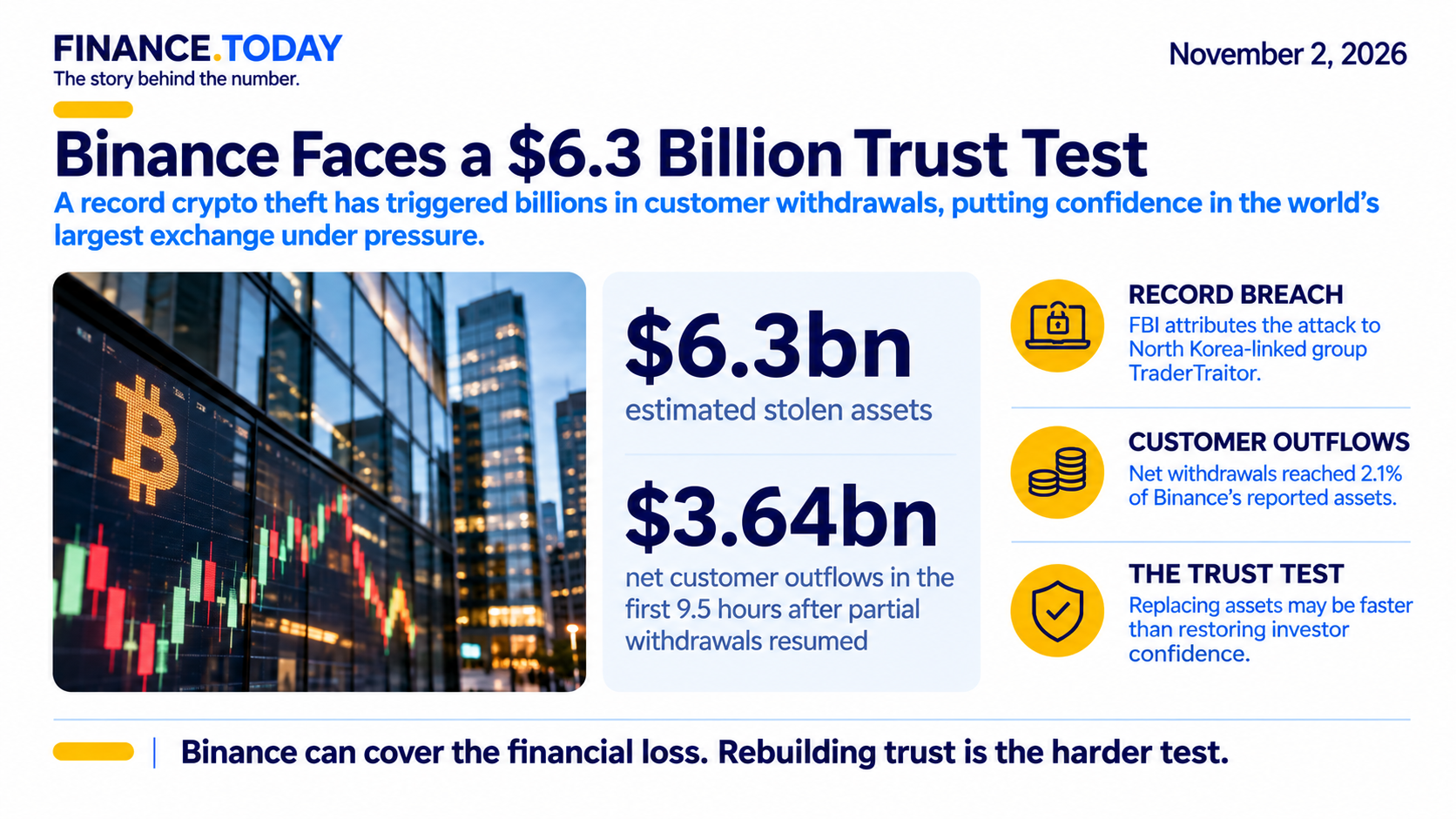
Binance is facing one of the most serious tests in its history after hackers stole an estimated $6.3 billion in cryptocurrency from the platform in an attack attributed by the FBI to North Korea-linked cyber group TraderTraitor.
The immediate financial impact has been substantial. After Binance partially resumed withdrawals, customers pulled a net $3.64 billion from the exchange in just nine and a half hours. The outflow represented around 2.1% of Binance’s reported assets, a figure some analysts described as relatively modest given the scale of the breach.
The exchange says it will bear the losses itself. Binance has reported replacing approximately 95% of the stolen assets and setting aside more than $6.3 billion from its corporate treasury, insurance funds and emergency reserves to cover the incident.
But the numbers tell only part of the story.
Liquidity is not the same as trust. Even if Binance can replace the stolen tokens, institutional investors, market makers and customers may reassess the risks of keeping large balances on centralised exchanges.
The breach has also unsettled the wider crypto market. Bitcoin recovered above $78,000 on Monday after touching a six-week low, while Ether traded around $2,287 following a two-month low. Meanwhile, spot Bitcoin exchange-traded funds recorded $643 million in outflows on Friday, and more than $1.3 billion in leveraged positions were liquidated.
The incident raises a broader question for the digital-asset industry: can platforms convince investors that customer funds are protected not only by reserves, but by security systems capable of preventing a breach of this scale?
The bottom line: Binance may have the financial resources to cover the losses. Rebuilding confidence across the crypto market could take considerably longer.
The Story Behind the Number.
