
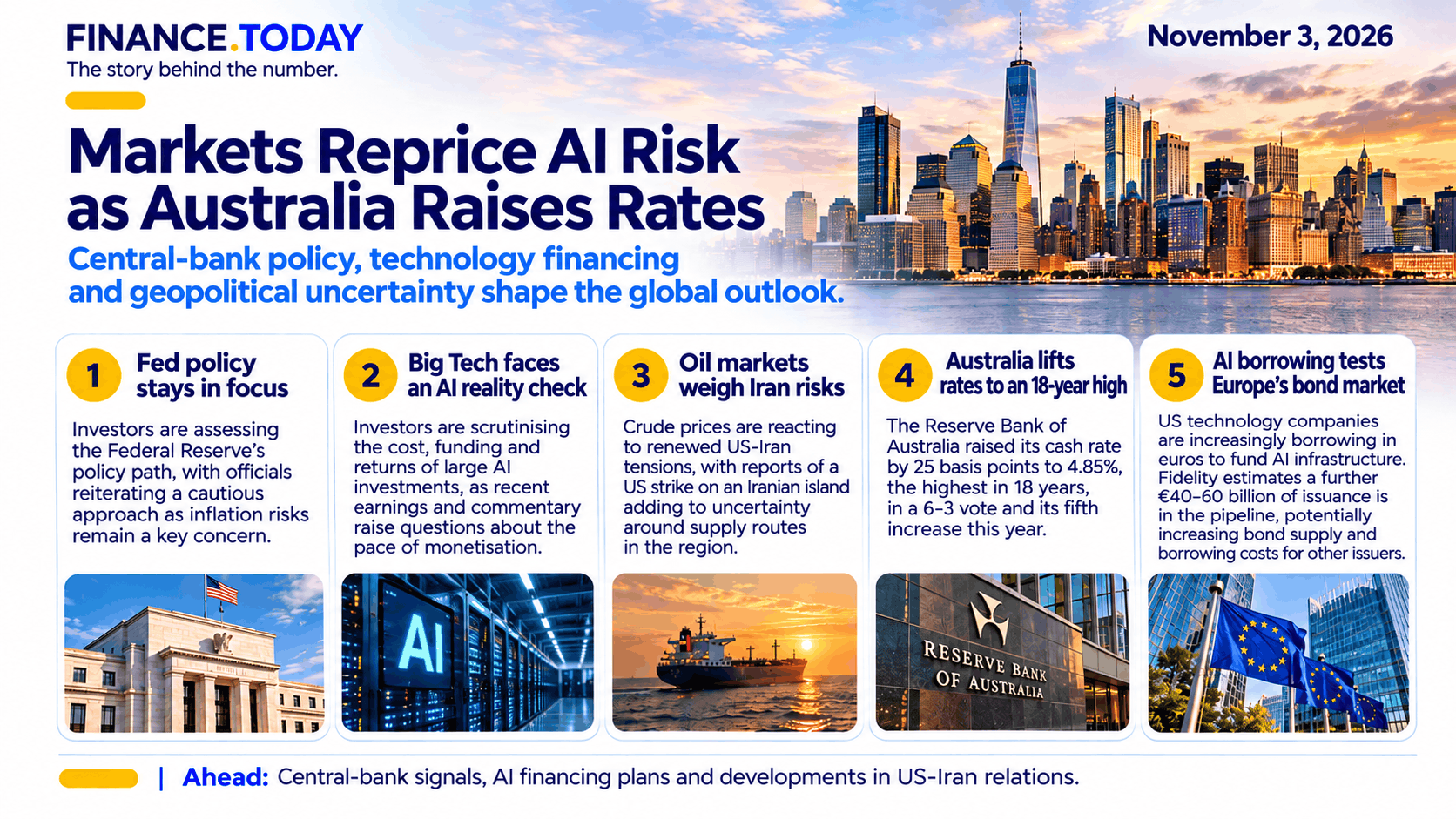

Five stories shaping global markets and business on November 3, 2026.
1. Federal Reserve policy remains in focus
The Federal Reserve’s decision to keep interest rates unchanged has not settled the debate over its next move. Several policymakers have argued that persistent inflation could require further tightening, while markets continue to assess the impact of elevated energy costs and geopolitical uncertainty. The tension between inflation control and economic resilience remains central to the outlook for borrowing costs. For investors, the direction of US monetary policy will influence bond yields, equity valuations and the cost of capital across global markets.
2. Big Tech faces an AI reality check
Investors are increasingly scrutinising the scale and financing of artificial intelligence investment. The infrastructure spending boom has supported technology valuations and broader market optimism, but questions are growing over how quickly companies can turn investment into sustainable returns. Reuters reports that concerns about high capital expenditure, debt-funded projects and the concentration of market leadership are adding to wider financial-market fragility. The key issue is shifting from how much companies can spend on AI to whether the resulting revenue and productivity gains will justify the cost.
3. Oil markets weigh renewed Iran risks
Oil prices edged higher in Asian trading after the Wall Street Journal, citing US officials, reported that the United States had struck Iran’s Qeshm Island. Brent crude rose 0.5% to $105.25 a barrel, while US West Texas Intermediate gained 0.5% to $96.93 by 01:04 GMT. The move followed a decline of more than 7% in Brent on Monday, when diplomatic signals had raised hopes of de-escalation. With shipping through the Strait of Hormuz still under pressure, any further disruption could quickly feed into energy prices and inflation expectations.
4. Australia lifts rates to an 18-year high
The Reserve Bank of Australia raised its cash rate by 25 basis points to 4.85%, its fifth increase this year and the highest level since 2008. The decision was split 6–3, with three board members favouring no change. The central bank cited broad-based inflation, higher fuel and commodity costs and tighter domestic capacity pressures. It also revised its inflation outlook, expecting inflation to remain elevated through much of 2027. The decision highlights how energy shocks and persistent price pressures are complicating monetary policy, even as households and businesses face higher borrowing costs.
5. AI borrowing tests Europe’s bond market
US technology companies are increasingly turning to European debt markets to finance AI infrastructure, adding to the supply of corporate bonds. Alphabet launched a €6 billion bond sale on Monday, its second euro-denominated issue this year. Fidelity International estimates that a further €40 billion to €60 billion of technology-related issuance could enter the pipeline. The additional supply may push borrowing costs higher for other companies and governments as investors absorb large deals. It also raises a broader question: how much debt can markets take on to fund the next phase of the AI investment cycle?
Ahead
Markets will be watching the reaction to the Reserve Bank of Australia’s decision, developments in US–Iran relations and the outcome of the US midterm elections. The RBA’s updated economic projections and further corporate borrowing plans will also help investors assess the outlook for inflation, interest rates and AI-related investment.
Sources: Reuters, Financial Times, Reserve Bank of Australia.
This digest is for informational purposes only and does not constitute investment advice.
The story behind the number.
— finance.today
