
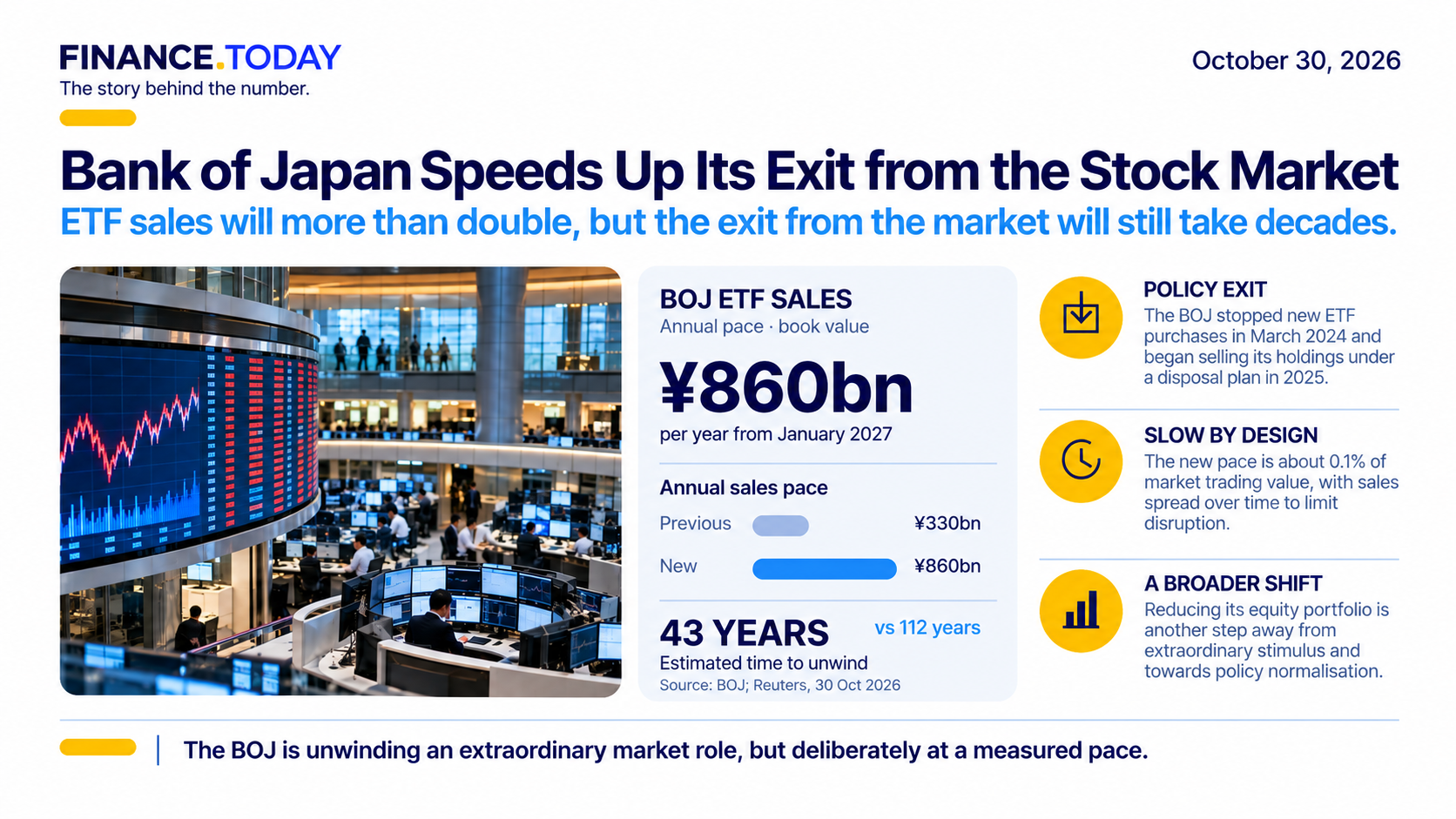

The Bank of Japan has announced plans to accelerate the sale of its exchange-traded fund (ETF) holdings, increasing the annual disposal pace to approximately ¥860 billion on a book-value basis. The revised plan, announced on October 30, is expected to reduce the estimated time needed to unwind the portfolio from 112 years to around 43 years. The new pace will take effect in January 2027.
The decision marks another step away from the extraordinary monetary stimulus introduced to combat deflation. The BOJ stopped making new ETF purchases in March 2024 and began reducing its holdings under an initial disposal plan in 2025, with annual sales of approximately ¥330 billion. The latest adjustment more than doubles that pace.
Despite the increase, the central bank is not planning a rapid withdrawal from Japanese equities. Sales are expected to remain equivalent to roughly 0.1% of market trading value, allowing the portfolio to be reduced gradually while limiting potential disruption to financial markets.
The move reflects a broader shift in Japan’s monetary policy. Normalisation is no longer limited to interest rates: the central bank is also beginning to reduce its direct presence in the stock market. The process will remain gradual, but the direction is becoming clearer.
The Story Behind the Number.
— finance.today
