
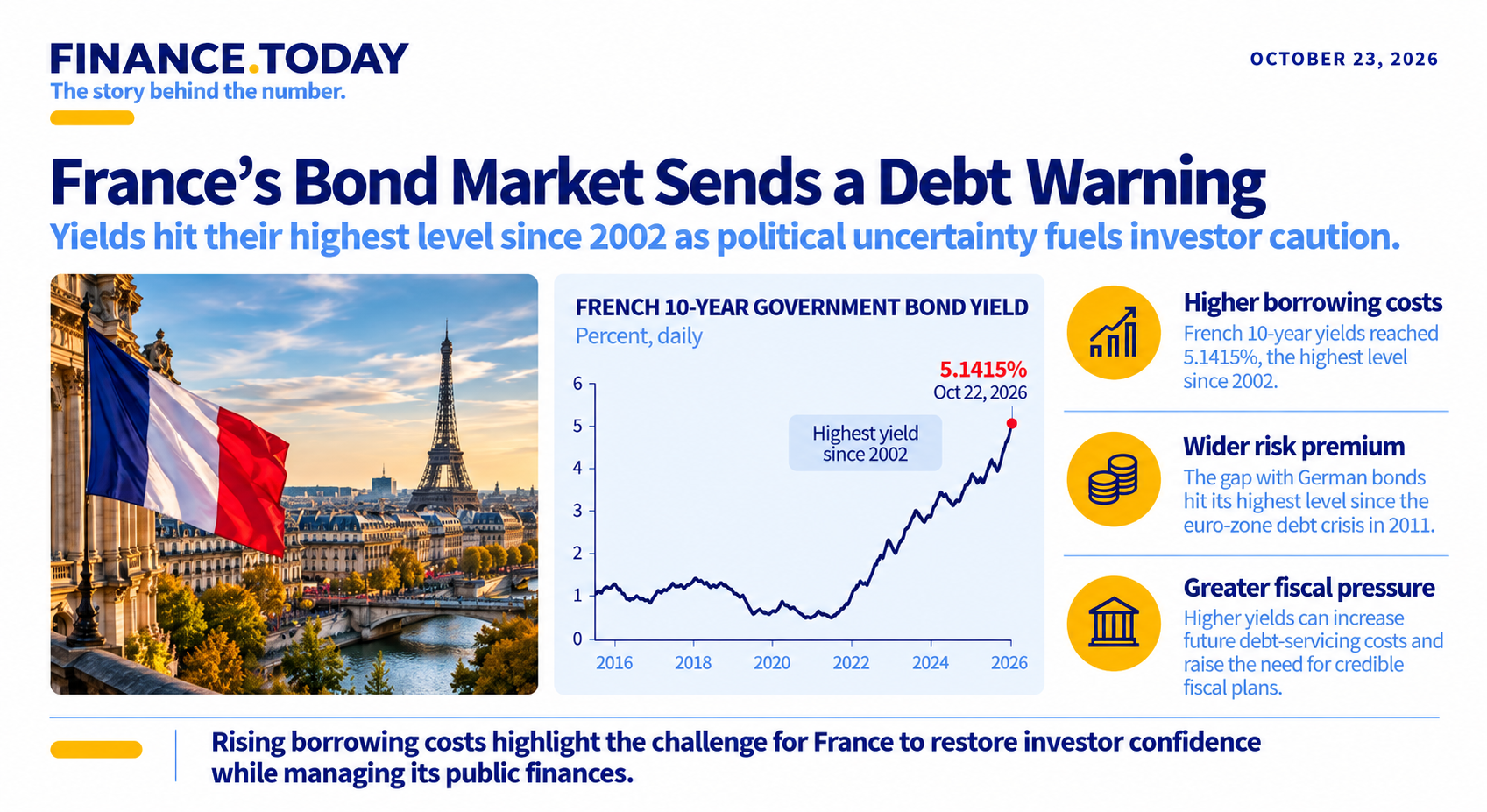

France’s borrowing costs have climbed to levels last seen in 2002, putting renewed focus on the link between political uncertainty, public finances and the price governments pay to borrow. On October 22, the yield on French 10-year government bonds briefly reached 5.1415%, while the premium over German bonds widened to its highest level since the euro-zone debt crisis in 2011.
Bond yields rise when investors demand greater compensation for holding a country’s debt, and bond prices move in the opposite direction. In France, concerns about the government’s ability to pass a budget and reduce its deficit have added to pressure from political uncertainty and public unrest. The widening gap with Germany matters because German government bonds are widely treated as a benchmark for lower-risk borrowing in the euro area.
Higher yields do not immediately reset the interest rate on all outstanding government debt. But as bonds mature and the state refinances them, elevated market rates can gradually increase the cost of servicing public borrowing. That leaves less room in future budgets for other priorities and makes credible fiscal plans more important.
The issue extends beyond France. If investors begin demanding a larger premium to hold sovereign debt, financing conditions can tighten across markets. The test for policymakers is whether they can restore confidence in the public finances without deepening political instability or undermining economic growth.
The Story Behind the Number.
