
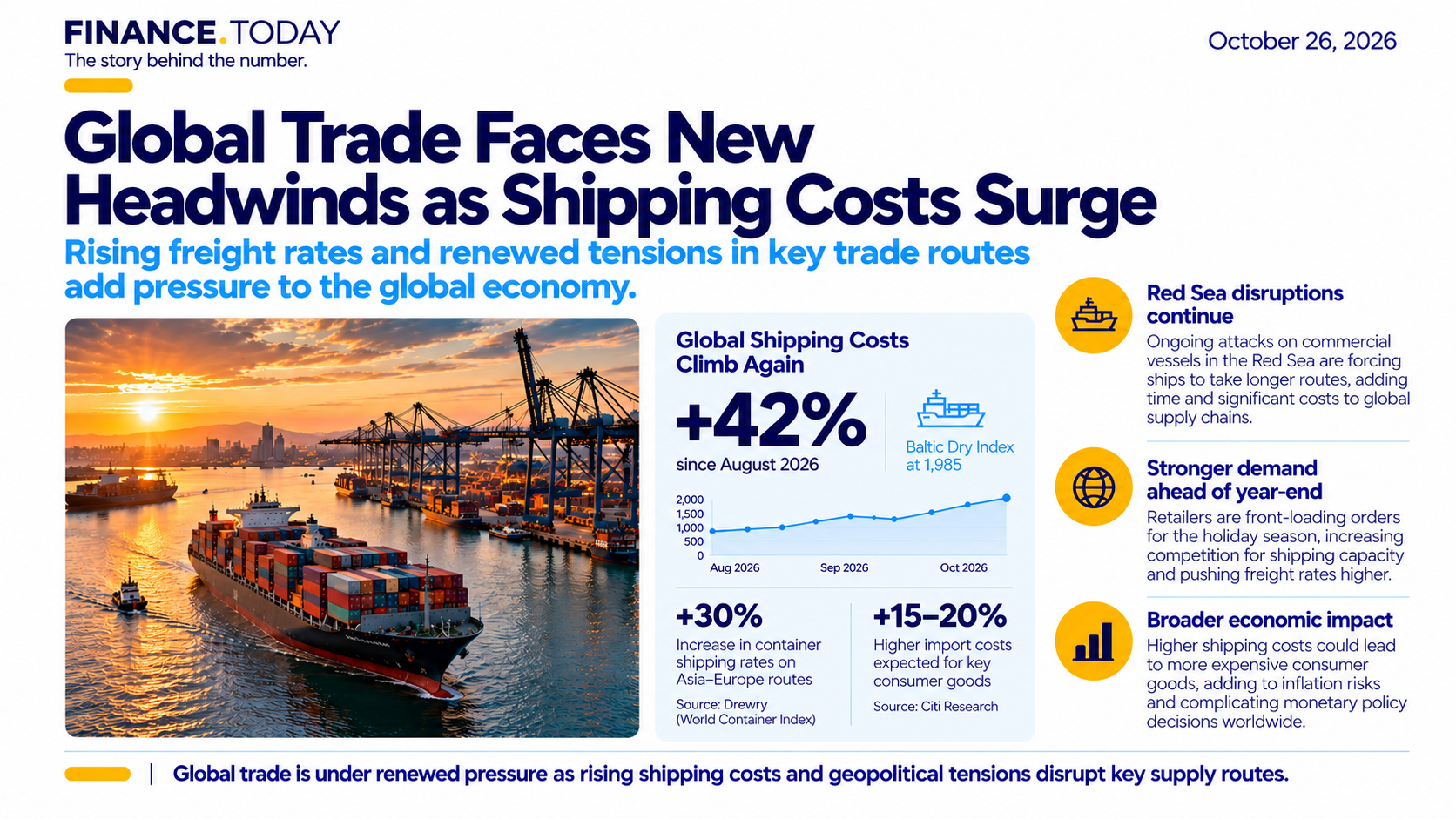

Global shipping costs are climbing again on some major trade routes, adding fresh pressure to businesses already navigating geopolitical uncertainty and uneven demand. Drewry’s World Container Index rose 5.4% in the week to October 23, reaching $4,585 per 40-foot container. The increase highlights how quickly freight costs can shift as carriers adjust capacity and respond to changing conditions across global trade lanes.
Security risks remain a key part of the equation. Attacks on commercial shipping around the Strait of Hormuz have intensified, while carriers are gradually restoring some services through the Red Sea and Suez Canal. These developments are pulling the market in opposite directions: longer or riskier routes can increase fuel, insurance and transit costs, while the return of vessels to shorter routes releases capacity and may put downward pressure on rates.
For businesses, the uncertainty matters as much as the headline price. Importers must plan around volatile freight charges, changing delivery times and the risk of higher landed costs. If transport expenses persist, companies may absorb the increase through lower margins or pass some of it on to customers, adding to inflationary pressure. Yet higher shipping rates are not evidence of a uniform global surge: prices vary considerably by route, and additional capacity is already limiting increases in some markets.
The story behind shipping costs is therefore a balance between disruption and capacity. Geopolitics can make trade more expensive overnight, but the longer-term direction will depend on vessel availability, demand and whether key routes remain safe and reliable.
The Story Behind the Number.
