
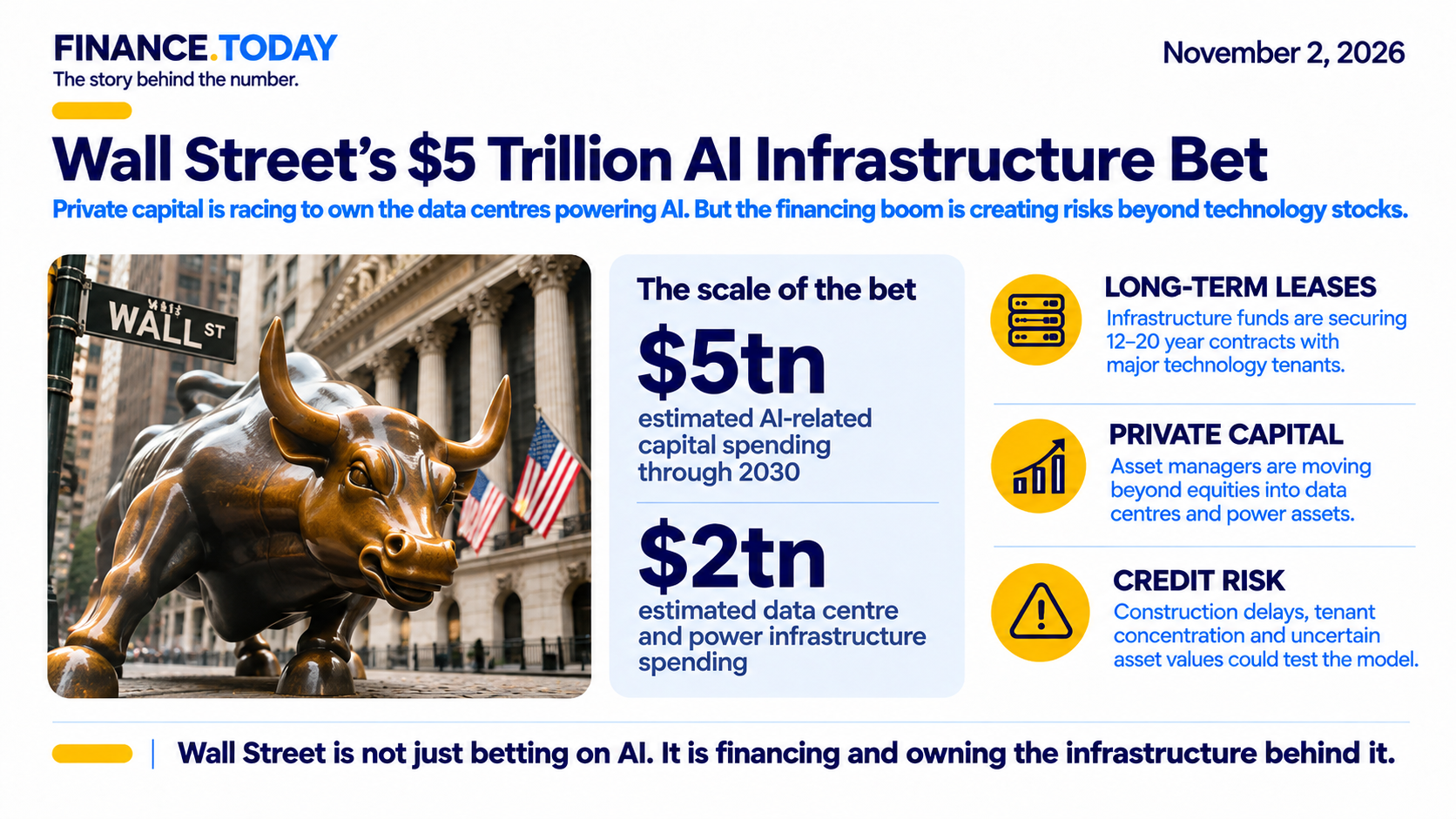

Private capital is racing to own the data centres powering artificial intelligence. But as financing expands, investors are taking on risks that go far beyond technology stocks.
The artificial intelligence boom is creating a new investment opportunity for Wall Street: instead of betting only on the companies building AI models, major asset managers want to own the infrastructure those companies cannot operate without.
Data centres, power capacity and long-term leases are becoming the foundations of a rapidly expanding financial market. Ares Management estimates that AI-related capital spending could exceed $5 trillion through 2030, including around $2 trillion for data centres and power infrastructure.
The strategy is already taking shape.
Blue Owl Capital says it owns or is developing more than 130 data centres, representing nearly 14 gigawatts of capacity, with another 21 gigawatts in its pipeline. Its leases typically run for 15 to 20 years and include rent increases over time.
Ares is pursuing a similar model, pre-leasing projects to investment-grade technology companies on contracts lasting 12 to 15 years. The logic is straightforward: secure a creditworthy tenant before construction, then turn the infrastructure into a long-term stream of rental income.
For private capital, this looks less like a speculative bet on the next AI winner and more like owning the digital equivalent of an energy utility.
But the model is not risk-free.
As financing spreads from equity and investment-grade bonds into leveraged finance and private credit, the sector faces growing exposure to construction delays, concentrated tenants, uncertain residual values and complex financing arrangements.
Moody’s has warned about these risks, including the possibility of circular financing, where companies and investors become increasingly dependent on one another to sustain the expansion.
The central question is whether demand for AI computing will grow quickly enough to justify the enormous infrastructure being built today. Long leases can provide revenue visibility, but they cannot eliminate the risk that technology changes, capacity becomes outdated or customers reduce their spending.
The bottom line: Wall Street is no longer just investing in the AI boom. It is financing and owning the infrastructure behind it. That could create a durable new asset class, or move the next major market risk from technology stocks into private credit.
The Story Behind the Number.
